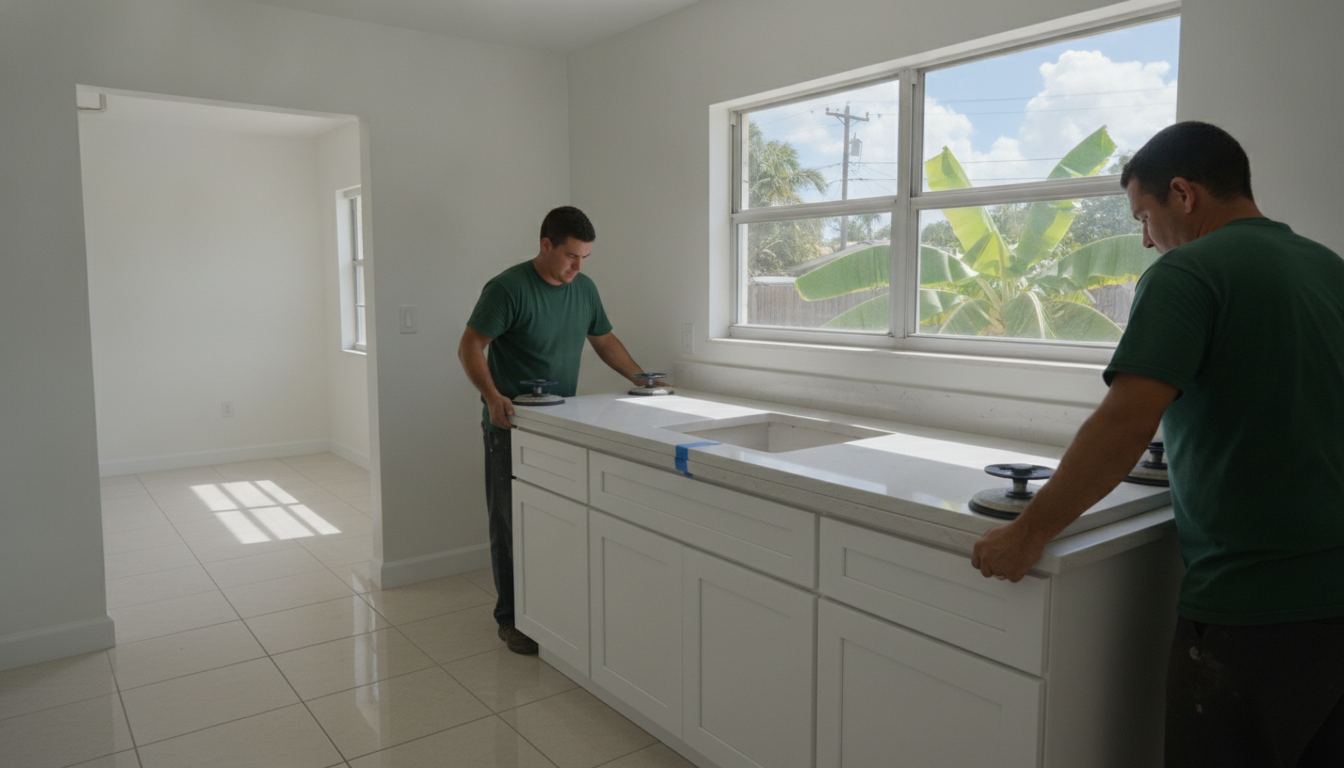
The installers packed up an hour ago, and you've been standing at the island ever since. The stone is exactly what you picked out, the edges look clean, and then there's that line running across the middle of it. It's the moment a lot of homeowners describe online, being excited until they saw the seam. Maybe it's the color, maybe it's how wide the seam is, and now you're wondering whether that's just what seams look like, or whether something went wrong.
It's a reasonable thing to ask, and the answer depends on a few things you can check yourself before you call anyone.
The short answer first
Should the seams on my countertop be this visible?
You'll almost always be able to find a seam if you look for it, but a good one is tight, flat to the touch, and filled with a color close to the stone, so it doesn't catch your eye from across the room. A seam that's wide, uneven under your fingers, filled with a color that doesn't match, or set somewhere you didn't agree to is worth raising with the installer while they're still on the job. Take photos in daylight and ask about it in writing, because that's much easier to sort out now than months later.
Why your counter has a seam in the first place
Stone and quartz come in slabs, and a slab only runs so long. When a counter run or an island is longer than the slab, or turns a corner, the fabricator has to join two pieces, and that joint is the seam. Homeowners with long islands run into this all the time, and on most of them a seam isn't optional.
Getting the stone into the house matters as well. A lot of Miami homeowners live in towers, especially in Brickell and the Arts and Entertainment District, where most homes are in large buildings, and a long piece of stone has to fit in the elevator before it can go anywhere near the kitchen. Condo owners on remodeling forums describe exactly that, with a building elevator too short for one piece the length of their island. In a building like that, a seam can be the only way the counter gets upstairs in one trip.
So a seam on its own isn't a defect. The way people who work with stone tend to put it is that you'll never not see a seam, but it can almost always be made to look better. Most of the frustration comes from that second part.
What separates a good seam from a bad one
Start with width. A well made seam is a thin line you notice when you're standing over it, and when homeowners post photos asking for opinions, how wide the seam is comes up again and again as the biggest issue. If you can catch a fingernail in the gap or the line is easy to spot from across the room, it's worth a closer look.
Then run your hand across it. The two pieces should sit flat with each other, so your palm glides over the joint without hitting a ridge. A lip on one side usually means the pieces weren't leveled before the adhesive set.
Then there's color. Installers fill the joint with an adhesive and tint it to blend with the stone, and when the tint is off, you get a line that reads gray or beige against the counter. A seam that looks beige often means a plain buff-colored adhesive went in without any color added. Some homeowners are told a dark fill will lighten as it dries, and it's fair to give it a few days, but if it still looks dark after that, it's worth asking about.
Pattern counts as well, especially on granite and veined quartz. When the two pieces come from different slabs or are turned the wrong way, the veins stop at the joint and the color shifts. A seam that doesn't match and also sits off center from where you expected it is two problems at once, and it's one of the more common stories homeowners post.
And check where it sits. Many installers try to keep a seam over solid cabinet support and away from the spot right in front of the sink, since the narrow strip there takes a lot of stress. If the seam landed somewhere you never agreed to, that's worth bringing up whatever it looks like.
Some stones show a seam more than others
The stone itself changes how much a seam shows, and that's worth knowing before you judge your installer too harshly. A solid, light quartz usually shows a seam more than a busy granite does, because there's no pattern for the line to hide in, and seams in darker stones tend to be less noticeable than seams in lighter ones.
That doesn't excuse a wide or uneven seam, but it does mean a tight, flat seam on a plain white quartz can still be visible in good light, and that can be a normal result for that stone. If you're still choosing, our countertops page covers what to think about before you pick a slab, and our piece on countertop and cabinet materials that handle Miami's heat and humidity compares the common options.
What to do if your seam looks wrong
Start with photos in daylight, one from a few feet back and one close up with something in the frame for scale. Then write to the company that installed it, describe what you see, and ask them to come look. Keep it in writing so there's a record of when you raised it.
A lot of seam problems can be improved once a fabricator comes back out. Depending on what's wrong, they may refill the joint with a better matched color, level a lip, or in a bad case, recut the piece. Not being happy that you can see it from across the room is a fair thing to tell an installer even when the seam is technically tight.
If you haven't paid the final balance yet, it's reasonable to ask for the seam to be looked at before you do. And if the countertop is part of a bigger kitchen job, the general contractor is usually the one to call, since they hired the countertop shop. Our article on whether a $50k kitchen estimate is high walks through what a kitchen quote should spell out, and it's worth adding seam placement to that list next time.
Before the next counter goes in
If you're still at the template stage, ask where every seam will go and have it marked on a drawing you can sign off on. Ask whether they'll lay out the pieces so the pattern lines up, and whether you can see the slab before it's cut. A few minutes on that drawing is far easier than living with a seam you never pictured.
It also helps to keep your payment schedule reasonable, so there's still money owed when the install is done and you can check the work first. If a deposit ever turns into a company that stops answering, our guide on what to do when a contractor takes your deposit and stops answering covers what Florida law says.
Getting the counter done right
If you're planning new counters, or a seam has you thinking about a redo, we can help with the next step. Miami Elite Remodeling doesn't do the work itself. We connect you with an independent remodeler who works in your area, and here's how that works. Our countertops page covers the kinds of countertop projects we help with, our kitchen remodeling page covers the bigger picture, and if you'd rather write the details out first, you can send them through our estimate page.
Call (786) 627-5048 and we'll connect you with a remodeler who works in Miami. Press 1, then choose kitchen or bathroom and enter your ZIP code.