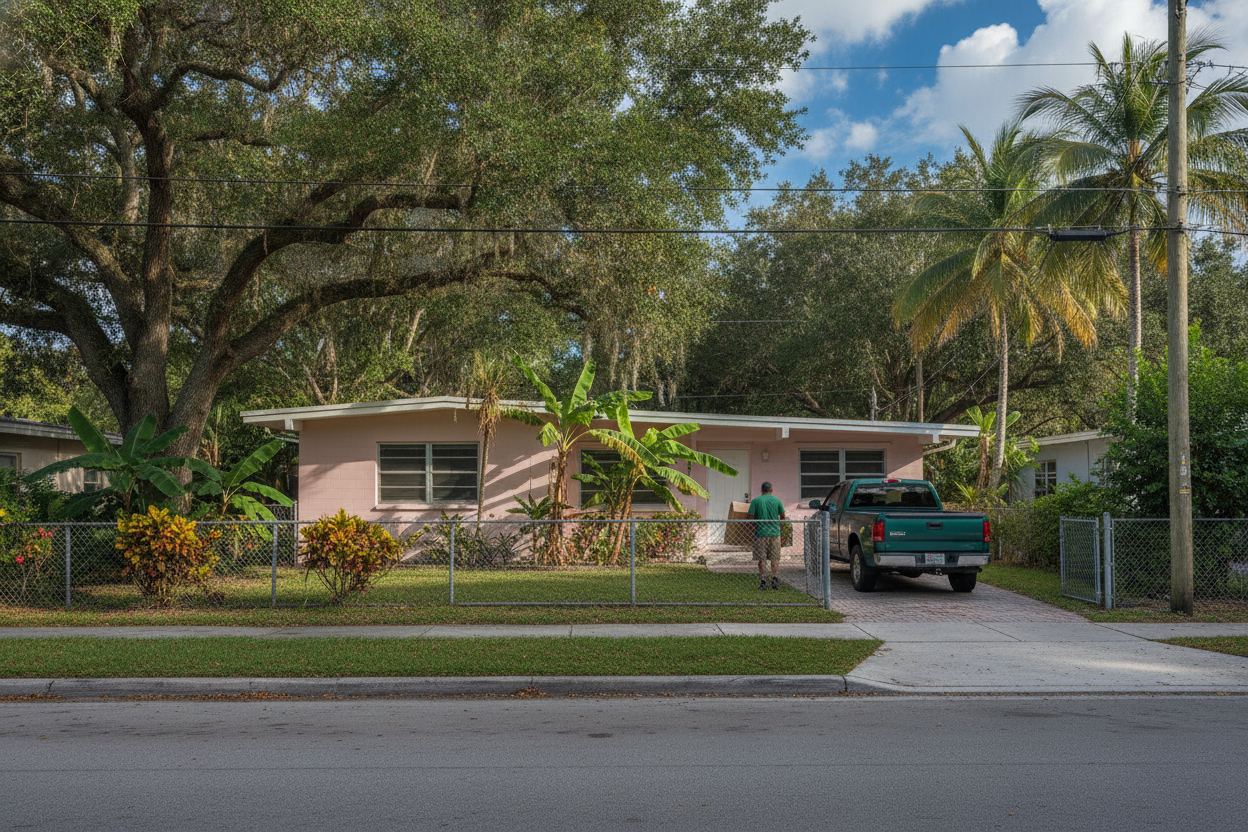
Wood, coral rock and big lots
The Grove has more houses than most of the city's older neighborhoods. Census figures for ZIP 33133 put detached houses at 35% of homes, with 53% owner-occupied. Half the homes went up before 1977, and nearly a third (31%) before 1960.
Some of what's here is far older than that. The West Grove's Bahamian settlers built wood-frame houses like the Mariah Brown House on Charles Avenue, from around 1890, and the E.W.F. Stirrup House from 1897. Others built in native oolitic limestone, the coral rock you see in old walls and fences. The Trapp House on South Bayshore Drive dates to 1889, and the Ayars House on Oak Avenue was built in 1923 by Bahamian stonemason Alphonso Beneby.
What that means for your project: cutting a new opening in a limestone wall is masonry work, and a raised wood floor in an old frame house deserves a close look for termites and rot before the new cabinets go in.
Conservation district rules, then the building permit
Grove permits are the City of Miami's, applied for in iBuild. If you live in the house and it's a one- or two-family home, you can pull an owner-builder permit.
The Grove sits in two Neighborhood Conservation Districts. NCD-3 covers most of it, and NCD-2 covers the West Grove and Charles Avenue. Their posted rules go past the usual permit:
- Demolition permits need a Waiver, a referral to Planning under the Tree Preservation Ordinance, and a certified arborist's tree survey.
- Green space has to equal at least 0.3 times the lot area.
- On new construction or garage additions, a garage door facing the street sits at least 20 feet behind the front wall of the house.
The city has proposed merging the two districts, so ask Planning for the current wording before you design around any number. Taking out a tree usually takes its own city tree permit as well.
If your house is individually designated, exterior work needs a Certificate of Appropriateness on top of the permit. The city's older preservation FAQ says interior alterations to most designated properties don't need approval. Confirm with the Preservation Office before you count on that.
Bay edge versus the ridge
The Grove's flood map splits sharply. FEMA's map puts parts of the shoreline at Peacock Park and Dinner Key in zone VE with a base flood elevation of 16 feet, and South Bayshore Drive near Mercy Hospital sampled as AE at 13 feet. Inland points, including Charles Avenue, Grand Avenue at Main Highway, and Tigertail Avenue, came back as zone X. Those were spot checks, not a ruling on your parcel, and FEMA's flood map will show the one that counts.
Hurricane Irma's surge pushed several blocks into the Grove in 2017 and flooded the Barnacle and Vizcaya, the Miami Herald reported.
If you're in VE or AE and the job costs half or more of the structure's market value, the City of Miami requires the house to meet today's flood code. The city takes that value from the Property Appraiser's building assessment, or from a Florida-licensed appraisal less than six months old. The land isn't counted.
Only in the Grove
- Tree fights are heating up. WLRN reported at least 14 tree-removal appeals filed in the city by early summer 2026, compared with one in all of 2025, and two September 2026 appeals at the City Commission involved Grove properties.
- Charles Avenue has its own design review. New construction there also goes to the Urban Development Review Board for scale, materials, roof slope and massing. A request to demolish a structure over 50 years old on the street goes to the Historic Preservation Officer.
- Nineteenth-century materials. Bahamian wood frame and hand-cut limestone mean a remodeler may be working with materials few Miami jobs ever see.
- Lots built for canopy. The conservation rules exist to protect the Grove's "heavily landscaped character," in the city's words, so additions run into lot and landscaping limits early.
Own a unit in one of the towers on South Bayshore Drive? The condo questions on our Brickell page will sound familiar.
Grove projects we can match you on
- Kitchen remodeling: opening a wall in an old house, after someone checks whether it's frame or limestone.
- Bathroom remodeling: a new bath in a raised-floor frame house, with the subfloor inspected first.
- Home remodeling: additions and whole-house work planned around green space and tree rules.
- Countertops: stone tops for a kitchen that has to suit a 1920s house.
- Kitchen cabinets: cabinets scribed to walls that were never perfectly straight.
- Flooring: repairing or replacing wood floors in a house that sits up off the ground.
Questions people ask
Do I need an arborist for a kitchen remodel in the Grove?
Often not, but ask. In the posted rules, the arborist's survey sits right next to the demolition Waiver requirement, and removing a tree takes a tree permit. If your plan knocks down any part of the house, raise both with Planning early.
Is my Charles Avenue house historic?
Some houses on Charles Avenue are individually designated, like the Mariah Brown House and the Stirrup House, and the whole street has its own review rules. The city's Preservation Office can tell you where your address stands.
Can I add a garage or a second story?
Often, but the conservation district rules set green space, garage placement and height limits. Have the remodeler or architect check the lot against them before you pay for full plans.
We live a few blocks from the bay. Should we be worried about flood rules?
Possibly. Parts of the shoreline map as VE and parts of South Bayshore Drive as AE, while much of the inland Grove sampled as X. Look up your own address on FEMA's map.
Find out what the city will let you build, then get a real price
Call (786) 627-5048 and we'll connect you with a remodeler who works in Miami. Press 1, then choose kitchen or bathroom and enter your ZIP code. Planning an addition? Pick whichever room the job starts in.